I built Biz-cen.ru , an office-rental proptech, and Lashoestring.com, a UK antiques e-commerce. I run a Telegram channel, in Russian. For contact — email. Writing from Berlin.

ENРУ
Later Ctrl + ↑

Entrepreneurship module

In September we had the first Entrepreneurship module as part of my MBA program at Skolkovo. We dove into how investment funds work, how companies are valued at different stages and how decisions are made in high-uncertainty conditions.

Abstract tangle of blue and red hand-drawn lines forming a loose network.

Before that, we had an “intro game” to get to know our group and the campus. Besides lectures and group work, the program included two guest speakers, a welcome evening with the MBA-7 group and a few organizational events. The daily schedule went like this: breakfast at 8AM, lectures and group sessions from 9AM to 6PM, a guest speaker from 6PM to 9PM and then group prep for the next day until about 1AM.

Before the module, they sent us pre-readings, mostly case studies, about 200 pages in total, plus a list of recommended books. Each case was a detailed breakdown of a real-world business, packed with metrics and in-depth descriptions of its processes.

Some of the cases were from Russia, but most were international examples. When I first started reading, I thought, “If it’s not about Russia, how is this going to be relevant?” Turns out, working through a case is really about learning the methods and approaches, and those are universal, no matter the context.
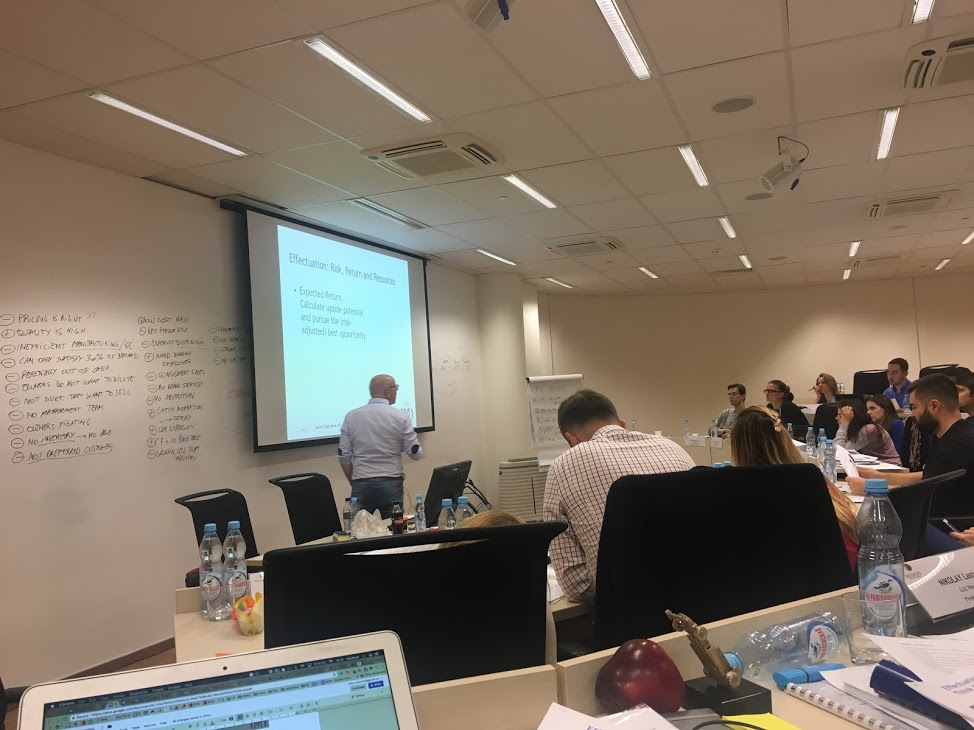
Business seminar room where a presenter stands at a projector slide on effectuation, students at tables.
View of the classroom during the lecture

The lecture part is always mixed with group work. Each group session ends with a presentation of our solution, followed by a discussion in the classroom. After that, the professor walks us through how the case actually played out in real life. My group had six people.

Everyone’s different, some have experience running production, others come from consulting or auditing. The group is super active and that’s probably the biggest challenge. At the start we spent a lot of energy just figuring out how to structure our workflow. You learn a ton from your classmates and even more, if you pay attention to how you behave in the process.

The course was led by Benoît Leleux from IMD. He’s originally from Belgium but spent many years in the US. He’s invested in 20 companies and had some level of involvement in every case we studied, you can really feel that. Here are a few key takeaways for me:

Raising money

— The cost of raising money for a startup is different at each stage. There are four main stages:

  1. Seed – when there’s just an idea and a team. At this stage, an investor might put money into the idea if the founders can convince them they’ll get a 75–100% annual return;
  2. Start-up – when there’s a product and the first sales in the target market. Here, investors expect around 75% annual returns;
  3. Growth – by this point, the core ideas are validated and funding is for scaling up. You need to show investors the company can deliver growth, returns of 25–50%;
  4. Late – when the company has already gone through its rapid growth phase. Funding usually comes not from funds but from corporate partners. For example, teaming up with a large company to access their customer base. Investors at this stage expect about 15–20% annually.

— A company’s valuation and the size of the funding round is always discussed together with the conditions the company must meet (with all the “ifs”). Valuation by itself is an abstraction, the terms make it real.

— Companies raise money in rounds because it makes the valuation more accurate. You give up a smaller equity stake, promise more predictable results and it’s easier to convince investors. This process is called staging.

— Staging is interesting because if an investor comes in during the first round and the startup delivers on its promises, the valuation goes up in the next round. Then the investor can sell part of their shares at a higher valuation.

— Staging also pushes founders to assess their company and their ability to deliver on all those “ifs” more realistically at each round. If they overvalue the company early on, they risk ending up in a situation where the share price in the next round is lower than in the previous one. And that’s a really bad signal for the market.

For example: we value our company at 10 million and raise 1 million for 10%. We commit that in 18 months we’ll have a working technology that can increase a sow’s litter size from 25 to 32 piglets.

— Reading TechCrunch announcements about funding rounds without all the “ifs” is pretty pointless;

— When raising money, negotiations are often all about those “ifs.” The conversation usually goes like this: “Whatever valuation you want, you can have it. But if you don’t deliver on all the ‘ifs,’ we’re taking it all back”;

— You don’t need to spend hours debating exact deadlines for each “if”, everyone just understands they need to be met fast;

— A normal, healthy entrepreneur hates risk;

— One idea kept coming up: Dilution is nominal. Run out of money is terminal;

— A business plan itself isn’t as important as the process of thinking it through;

— Early-stage startups aren’t really interesting to clients or big companies. First, you have to earn their trust.

Negotiating with investors

— Investors use three moves to test whether a founder is realistic:

  1. They ask if the founder understands that a different CEO could be brought in if that person would be more valuable for the company. If the founder freaks out, it’s a red flag, they could end up hurting the company. You can’t think of yourself as untouchable.
  2. They set up a board of directors with four investor representatives and only one from the founders’ side. Investment funds have the reputation of being laser-focused on making money, while founders usually don’t have much reputational weight yet.
  3. When the founders present their business plan and all the “ifs,” investors might say: “Okay, we agree with your valuation. We believe you’ll hit revenue of N with the profitability you’ve outlined. But let’s include in the agreement that no dividends will be paid until you actually reach N with all the ‘ifs’ met.

These kinds of questions are called ‘smoking out of entrepreneurs’.
Experienced founders respond with something like: ‘No problem, of course we’re committed to hitting the targets we set. But if we reach them in N months, we want to keep a bigger share of the equity.’

— If a company raises funding but doesn’t become a unicorn, just turns into a ‘walking zombie’ with steady revenue, investors can ask to have their money returned with all the accrued interest. Only after that can the founders start taking a share of the dividends.

Due Diligence, the situation in Russia and sexy businesses

— It’s harder for B2B companies to go public because, at the end of the day, it’s ‘regular’ people buying the shares;

— A business plan itself isn’t as important as the process of thinking it through;

—A pitch deck is never truly finished, it’s an endless iterative process;

— Big companies often avoid entering the same market with a new technology because of the ‘why shoot yourself in the foot?’ mentality. (By the way, there’s an explanation of this in The Innovator’s Dilemma );

— Once an investor confirms they’re ready to invest, a Term Sheet is signed and the Due Diligence process begins. During Due Diligence they check the founders’ and key team members’ backgrounds, the functionality of the solution, potential patent infringements and the overall ‘cleanliness’ of the company. This process can take quite a while and cost anywhere from a few thousand to several million dollars. Only after that is the investment agreement signed;

— There are few investment rounds In Russia or business acquisitions because doing a full, legally sound Due Diligence is often nearly impossible;

— If the round closes, the startup pays for the due diligence. The cost is deducted from the funding amount;

— A situation where a startup takes the Due Diligence report from one investor and shows it to another is basically impossible. Investors are usually more like friends than competitors;

— Investors insist on getting preferred shares, which give them priority in getting their money back if the company goes bankrupt;

—It’s always better to have more resources than you think you need. That gives the company more resilience. If you don’t have that buffer, cut down the number of directions you’re working on;

— In developed countries a lot of processes are outsourced. In developing countries that usually doesn’t work, there just aren’t companies with well-established specializations. That’s why many businesses end up being vertically integrated. For example, a model pig farm might start selling specialized feed storage platforms to the market because they had to figure out how to make them themselves and the product turned out to be in demand;

— You win long-term if you’re a maniac about operational work;

— Slip age is when the business is making money overall, but you don’t really know which areas are driving it and you fail to notice when a part of the business is running inefficiently;

— Some brands make products specifically for sales. For example, Nike has collections that are sold only in outlet stores;

— Do not ask for permission, ask for forgiveness. A short way to describe the entrepreneurial spirit inside a company;
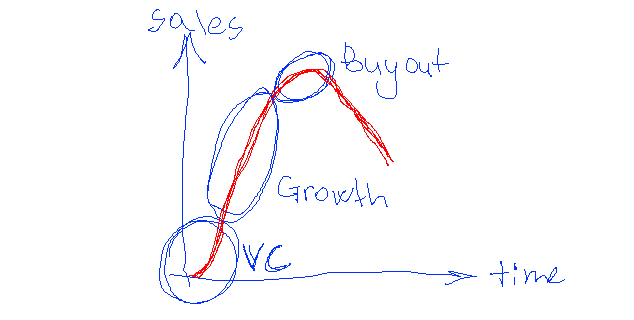
Hand-drawn sales-versus-time chart with a rising curve marked VC, Growth and Buyout stages.

— Companies can roughly be divided into three types: VC / Startup – no established model or market yet, business processes are still messy. Growth – the model works, and the company is in a rapid growth phase. Buyout / Mature – the business is stable and fully developed. The VC stage is what many entrepreneurs see as the ‘sexy’ business. But there’s often more money in the third stage, which people tend to ignore because it seems boring. Benoît admitted he loves boring businesses – the more boring, the better, in his view. Sexy businesses always have more competition, full of players chasing their ego rather than making money.

About entrepreneurship

— Management is creating a role that others perform, while you remain responsible for the outcome;

— People see the world differently. Some think it’s completely unpredictable, so why bother making any plans? Others believe it can be predictable, so if you have a stable job and salary, you’re safe. In reality, the world is somewhere in between, with a high level of unpredictability;

— Entrepreneurs spend their time gathering means, methods and leverage points. Once they’ve built up enough, they discover new opportunities. Steve Jobs’ Stanford speech touches on this;

— Methods build up by answering these questions: Who am I? What do I know? Who do I know?

— Start with intention, don’t wait for opportunities to come to you.

Conclusion

The module gets a 9 out of 10. The best part is: it set a high bar for the rest of the courses and the material is packed with value. The pre-readings and group work add a lot. The downside is that the guest speakers didn’t really connect much to the module’s topic.

How I applied for an MBA at Skolkovo

I first heard about the MBA program in my third year of university when I launched my first project – the branding agency AGRRR. Back then, I thought it would be great to gain that kind of experience. Now, I can explain that I need an MBA to strengthen my skills in financial planning and strategic management. I also want to build useful connections since I plan to continue doing business in and from Russia. But most likely, I actually formed the real reason for pursuing it back in my third year.

Hand-drawn letters MBA in blue with a red raised fist forming the central letter.

Choosing a school

To choose the right school, I attended two MBA program fairs and spoke with students from Harvard, Haas, INSEAD and HEC. In 2015 I went to London for a presentation at the London Business School. There were 7 people at the presentation: 5 Indians, 1 American and 1 Norwegian.

At the same time, I was learning English because I knew I needed a couple of certifications such as GMAT and TOEFL for admission. By the end of university, my English was still weak, so I had to start from scratch. I decided to begin with the TV show “The Walking Dead,” watching it in English with subtitles. Not the best choice, since most of the episodes were filled with zombie growls. After that, I switched to lessons with tutors.

The more I looked into the schools, the more I realized that the program is primarily for those building corporate careers. Even at institutions that promote entrepreneurial spirit, like Haas, after graduation, most students end up working as employees. The second thing that bothered me was the need to take a break from the projects I was working on for a year or two. At that point, I wasn’t considering part-time programs.

Getting to know Skolkovo

In February 2017 I saw an ad for the MBA at Skolkovo and decided to visit the campus. I was sure it would be my first and last visit to the school, as I was biased against MBA programs in Russia. It seemed like in Russia, everyone was just trying to make money off MBA education, no matter who they were. During the presentation at Skolkovo, I heard some important points:

  1. The program lasts for 18 months, in a modular format – one module, one topic, one week per month. During this week, you live on campus, with classes running from morning until late evening. You balance the program with work, immediately applying what you’ve learned in practice;
  2. There are 50 people in the class, half of them are entrepreneurs. Maybe there are a lot of entrepreneurs at Stanford or MIT, but this is not typical for European institutions. And it’s always more interesting with practitioners, people who know how to take responsibility;
  3. Classes are in English and the instructors are visiting professors from Cambridge, IMD, ESADE, IESE. The way they present it is this: the format of bringing in professors from other schools allows them to invite the best experts in their fields. International practices are taught with a focus on the specifics of the Russian market. The program also includes two international modules: one in Silicon Valley and another in China.
Moscow School of Management Skolkovo, a striking modern building with stacked reflective glass blocks.
The building where classes take place

How I applied

I decided to apply. The first step was preparing the document package: my diploma, resume, a couple of recommendations and answers to 4 questions about motivation and plans. I sent the documents on April 5th. The second step was an interview on campus, an English proficiency test and a logic test. I arrived on campus on April 18th. The interview was with Nadezhda Agapova and it lasted an hour and a half in the format of a friendly conversation. That same day I received confirmation that I passed to the next stage – an in-person interview with one of the founders of Skolkovo.

On April 25th along with 5 other potential students, I went to a meeting with Andrey Rappoport. At the stage of the interview with the founder, 30% of the students are eliminated. What I remember most from the meeting is how Andrey Rappoport explained that he and the other founders created Skolkovo because they realized the need to develop a new generation of managers in Russia if we want meaningful changes in the country. We discussed how Skolkovo pays attention to the legacy of the Russian management school of Georgy Shchedrovitsky. When I read Organizational Management Thinking, I couldn’t believe that someone in Russia could think so comprehensively and consistently about management processes, highly recommend reading it. A week later, I received word that the interview went well, and I was accepted.

Grant competition

At Skolkovo you can win a grant that covers up to 50% of the tuition fees and I decided to participate. By early June, there were 270 people applying for the MBA program. Among those who passed all the admission stages 16 projects were selected to take part in the competition.

As part of the competition, we had to present our project in a 5-minute pitch and answer questions from the jury. The jury consisted of top managers from renowned companies like MasterCard, Wimm-Bill-Dann and Rostelecom. I was the first to present, which I was glad about. Waiting for your turn while watching others present can be nervous. The projects varied: medicine, blockchain, real estate, oil development. The main prize of €30,000 went to my future classmate Samvel, who develops electric vehicle charging stations using Russian-made components. Most of the projects were strong, well-developed, with excellent presentations. It was especially satisfying to win a €15,000 grant in such a competitive field.

The first module starts in September. Let’s go.

Thanks to: Oksana Sichenikova, Maria Polikarpova, Nadezhda Agapova, Maxim Feldman, Erik Brovko, Denis Sobe-Panek, Boris Fizulov, Evgenia Gekman, Darya Kholodova, Lydia Agafonova, Grisha Maslak and Vladimir Gorovoy.

Marketing on marketplaces

About half of our clients come through marketplaces and classifieds, so we’re always working on improving how we market through those channels. For Biz-cen.ru we use platforms like Cian, Yandex Realty, Avito and others. With LavishShoestring.com, our vintage goods project, we listed items on Amazon, eBay and Etsy. While paid search ads come with tons of settings and detailed analytics, marketplaces don’t give you that kind of control. So, to attract more customers, we build custom tools on top of those platforms.

Hand-drawn lettering reading Avito & amazon in red and blue.

The built-in marketing tools on marketplaces often make it surprisingly hard to understand how listings are ranked. For instance, on Amazon, tracking daily views for a specific category means manually logging stats day by day, adjusting the date range each time. And Avito still doesn’t show a daily breakdown of views, you can only see the total number of views since the listing went live.

There are two main reasons:
— First, marketplaces don’t want to overwhelm users with too many settings. They stick to a simple model: want more customers? Pay the platform more. On eBay, for example, you can boost your ranking in search results, but only if you agree to give the platform a bigger cut when the item sells.
— Second, building solid advertising tools inside a platform is tricky. It’s a balancing act. If they give sellers too much clarity, say, explaining how headlines affect ranking, some businesses will game the system to climb higher in the results. That might work for sellers, but it often leads to messy, unreadable titles for buyers.

We study each marketplace’s search algorithm and build custom layers on top of their internal analytics systems. To make sure the way we optimize our listings actually leads to more sales, we run experiments. And since marketplaces don’t offer tools for quick testing, we automate the whole process ourselves.

An example of our work to boost sales on Amazon
To boost item sales on Amazon, we started by building keyword sets for each product category, vases had their own, decanters had a different one. Next, we created an auto-generator for titles that pulled info from each item’s questionnaire and began testing how the order of words in the title affected search rankings. Then we moved on to bullet points, experimenting with how different descriptions impacted visibility and conversions. After that, we added up to 1500 relevant keywords to each product. Amazon doesn’t let you include keywords during bulk uploads. So we had to build a separate module that updated each listing after it was already live.

Working to grow customer traffic from marketplaces is a niche in marketing that very few people tackle professionally. Every now and then, a new tool pops up that automates a small part of the process, but I’ve never seen a single product that fully covers even one marketplace end to end yet.

Telling the difference between Pretenders and Problem-Solvers

In our company, there are people who know their stuff way better than I do. And when everything goes according to plan, things run smoothly. But real work always brings surprises. So how do you tell if something went wrong because of the employee or not?

When progress in some area stalls for a while, I see two possible scenarios. In the first one, the work is actually being done right: solid hypotheses are built, tested and refined. Let’s call these folks the Problem-Solvers. In the second case, the person just doesn’t have the necessary knowledge or skills. Let’s call them the Pretenders.

Rows of scribbled letters: red attempts forming the letter A above blue attempts forming the letter B.

Over time, I’ve come up with a way to spot the difference. Problem-Solvers are open during discussions. They take responsibility for mistakes, explain what’s going on in plain language and lay out a clear path forward. Their mindset is: “I know I can figure this out, I learn from my mistakes.” Pretenders, on the other hand, speak in circles, avoid clear answers and tend to blame others. Their driving force is fear of being discovered. They often rely on past achievements to cover up current gaps.

I’ve never been able to turn a Pretender into a Problem-Solver. My take is that the Pretenders have built a life around avoiding responsibility, not just at work. Real growth, I believe, only happens when someone takes ownership of their life. But when fear is the main motivator, people only learn just enough to stay hidden. That’s a dead end.

In a perfect world, a good leader knows how to spot and keep the Problem-Solvers and filter out the Pretenders before they even make it past the interview.

How to find a partner who will help you enter a foreign country?

As I stated above, I did not know anyone in the real estate market in London. However, I felt that we needed someone who could help us find answers to our outstanding questions and help organise meetings in London with landlords, brokers and perhaps some leasing agents as well.

Simple drawing of a tangled red scribble on the left resolving into a smooth blue line heading right.

To this end, I first updated my LinkedIn profile with information that we had a plan to open an office in London. Next, I upgraded my profile to the PRO version and started contacting anyone who had any links with the real estate market in London. I said that we were looking for a partner there and asked candidates for a Skype conversation. I had conversations with several people from LinkedIn, during which we discussed our Biz-cen project and their attitude towards participating in it. In the end, however, we did not move from talks to concrete actions.

Secondly, I posted a vacancy at two head-hunter (recruitment) sites; one in Moscow, one in London After holding several Skype interviews with potential candidates, it became clear that our plan to open a London office came across as being a highly speculative start-up plan. People looking for jobs online rarely look for positions at start-ups. As a result, I did not find anyone who could help us achieve our goals.

Thirdly, as we were well-established in Russia, I already knew several senior managers in London-based real estate companies. Communicating with one such manager, I was assured that he would talk with his colleague in their London office. However, he did not provide any valuable information after our meeting.

In the end, I made some progress through blind luck/by pure coincidence/purely by coincidence. While I was trying different ways of finding someone in London with valuable expertise, my friend Sasha Grigoriev was teaching at Zelman Schools in London. There, he met Jacob, obtained his business card and passed it on to me. I made a pitch to Jacob, and he agreed to help us to organise the necessary meetings in London.

Earlier Ctrl + ↓