I built Biz-cen.ru in Russia, Lashoestring.com in the UK. I run a Telegram channel. For contact — email. Writing from Berlin.

ENРУ
Later Ctrl + ↑

Immanuel Kant “The Metaphysics of Morals”

What is a “just war”? Why can full-blown democracy be just as terrifying as tyranny? When is it okay to force your will on someone else? Is it possible to criticize a national trait and still be a citizen? Why doesn’t logic always explain everything? And how is the fact that land is limited connected to the rise of laws and the birth of the state?

Hand-drawn line portrait of a curly-haired man's face, hair in red and features in blue.

Innate thoughts and ways of knowing

Kant lived from 1724 to 1804 and is considered one of the founding thinkers of European liberalism. He drew a sharp line between nature and freedom. His work laid the groundwork for the German constitution and helped inspire the liberation movements and liberal values that shaped 18th-century Europe.

In the first part of his life, Kant followed European rationalism. For rationalists, the core idea is innate knowledge, something we’re born with. It’s not learned from experience, not something we invent and definitely not a product of imagination. Their go-to method for figuring things out is deduction.

Here’s a simple example of deduction: the idea of God as something we’re born with. You can’t understand God without first realizing who you are. You see yourself as a limited, uncertain person, someone who doubts and struggles. And if you feel doubt, it means you’re not all-powerful. You can only understand that you’re imperfect if you compare yourself to something perfect – God. Innate ideas aren’t just about logic or strict beliefs. They’re more than that.

Transcendental means a type of knowledge that looks at how we understand things, not the things themselves, but how our mind works when we try to understand them.

Kant’s revolution in Philosophy.

Pre-Kantian philosophy is known as the dogmatic way of thinking. It’s based on the idea that our thoughts or ideas must match reality, that’s how we come to know something. This view sees truth in two ways: as accuracy (matching reality) or as correctness (following certain rules). Correctness – our thoughts are true if they follow the mental rules we use to understand things. So, something is considered real if it fits the way our mind naturally organizes experience. Kant introduced the idea of the a priori – built-in structures in our mind that shape how we experience the world. The a priori lays down the framework for how experience unfolds. For Kant, truth is always tied to possible experience

Before Kant, space was thought of as something the mind creates – a product of thinking. But Kant argued that to even understand space, we already need an inner sense of it. This shows that concepts don’t just come from abstract thinking, they depend on mental structures we already have. Without those, we wouldn’t be able to grasp the concept at all.

In any kind of knowledge, there are two parts: our senses and our understanding. Understanding is then split into the mind and reason. The difference is that the mind works with things we can actually experience, while reason tries to go beyond that.

According to Kant, reason finds in things only what it has already put there to begin with. The unconscious already holds everything within itself, it just gradually uncovers things as experience unfolds.

For Kant, experience always means what we take in through our senses. That’s where the a priori starts to show up. We can only know things if they’re given to us in experience. Any object is really just how the mind puts different parts of experience together into one whole.

It’s the mix of sensations that makes something real. We don’t control what we feel and our mind isn’t the one creating it. You can take what seems like the same thing, break it down, and realize it’s really just a structured set of sensations. That moment when you try to understand an object by focusing on how it feels – that’s as far as reflection can go. Our senses are the passive layer of consciousness.

The categorical imperative is the core of Kant’s ethics.

There’s the realm of actuality and appearances, and then there’s the realm of duty. In the phenomenal world, we’re driven by sensory pleasures. But in the moral world it’s the imperative that rules.

We’re looking at two opposing realms: the domain of physical life – nature and the domain of morality – ethics. And this distinction is absolutely central to Kant. The categorical imperative is the maxim of your will. What matters most is that the principle behind your action could be made universal. That alone has the power to liberate. Because no being should ever act toward another in a way that denies their belonging to the human race – that is, their conscience, their rights and ultimately, their freedom.

And we slip into something less than human when we allow the human in us to be diminished. In other words, if my rights are violated and I don’t stand up for myself, I’m not just letting it happen – I’m disrupting the metaphysical order of the world. I’m committing a moral offense against myself.

Freedom, Right and Morality: Kant’s Triad

Kant’s distinction between morality and right. The essence of being human lies in our freedom. In this sense, right is the meeting point between freedom and nature. By definition, a human being is free. They have the right to full authority over everything that belongs to the realm of nature.

Right concerns only the external and actions or, in Kant’s terms, it doesn’t touch the grounds or motives behind those actions, or the way of thinking that guides them. Right exists solely in the realm of actions. And the moment it starts creeping into the realm of free discussion, into the realm of thought, then, according to Kant, the state can go away. A civil servant, once home, can write whatever they want in a journal, publish it and share it however they want. For example, they might argue that Islam’s influence has a negative effect on their country’s folk traditions, because Islamic music is built on a different tonal structure. And then that same civil servant shows up to work and follows the rules, treating their fellow citizens, including Muslims, with the same respect as anyone else.

Today we live in a world where words are treated as if they were actions. And Kant’s domain of freedom is under attack. The clash of opinions doesn’t belong in the legal realm.

A crime committed out of need is still a crime. Bourgeois law, on the one hand, upholds the principle of equality, on the other, it conceals inequality. The moment law becomes politicized, it starts being applied selectively, based on context. And at that point, what is legal turns into something political. Law still exists, but it starts functioning as an instrument of added force.

There are two Kant’s core principles:

  1. Right – its universality;
  2. Peace – the cultivation of a moral way of thinking.

According to Kant, land becomes property the moment there’s any act of will to claim it, for example, marking off a plot with stakes. Before that, the land belonged to whoever was working it.

On the separation of powers, the impossibility of direct democracy, and the danger of despotism

In Kant’s time, society was still waiting to be freed from the monarch, as republics hadn’t yet taken shape. Kant’s approach to forming a civil community isn’t based on the idea that life will simply get better if people live together. That, however, was the core assumption of classical Enlightenment thinking.

A desire matters simply because it belongs to the will of choice and that’s the domain of freedom. To follow the law is a moral duty. For Kant, right is grounded in personal freedom or in morality. For Hegel, it’s grounded in morality, not in ethics. Morality arises from the freedom of the individual will. Ethics, on the other hand, comes from being embedded in social contexts, shaped by the spirit of your people.

According to Kant, right is the set of conditions under which the will of one person can coexist with the will of another, according to a universal law of nature.

Strict right is based on the idea of external force, the right to mutually require certain actions from one another, but always under the rules of freedom.

The law of freedom means: I have the right to do anything, as long as it doesn’t interfere with anyone else’s freedom. No person can be denied the ability to exercise their freedom, which ultimately includes the right to own property.

Right has no power to establish morality, it’s indifferent to motives. Right doesn’t regulate thought, because thought belongs to the realm of the subjective. From this follow the key principles: freedom of speech, freedom of conscience, freedom of religion, freedom of belief and freedom of the media.

Morality is governed by the categorical imperative – act only according to that principle which could become a universal law. So that no one in this society, including yourself, is excluded from that right. And the first thing you must do is refuse to let anyone treat you in a way that violates your rights.

The right to freedom and how that right gives rise to civil society

I can require someone else to follow the law and by doing that, I’m also requiring them to join civil society. But their personal morality isn’t being controlled. To help a child become a person, we teach them:

  1. To take care of their basic physical needs, like not to soil themselves.
  2. To use reason, like not grabbing a live wire.
  3. And to develop morality, like not poking other people with a screwdriver.

Only then they become a person and truly be free.

Mamardashvili said: “We don’t judge people, we judge actions. Let God judge the person.” The first thing I have an external right to is my body. And that means originally mine is: the place I was born and the work I do.

The basic form of property is the right to land. Every person has a right to their own share of the land, because the land isn’t an endless plain. If it were infinite, we could just spread out forever and never have to interact. But it’s limited and we’re forced into contact and that leads to the creation of civil society.

To “claim land”, I have to mark it in some way, in Roman law, that used to mean working the land. The moment I make that claim, I bind myself to things.

In primitive societies, there’s no trade or exchange, because the best thing is the thing I made for myself. Why would I trade the axe I crafted to fit my own hand for anything else? Every act of exchange feels like a loss, a concession that doesn’t benefit me.

Working the land is one way to mark a claim to it, but just as important is an act of will. My property extends as far as I can maintain control over it. The push toward human interaction starts from a purely material condition, while the concept of property itself is entirely idealistic. The boundary of the original claim is the boundary of force.

The question of property and the state

Within a legal system, we must never ask the question, “Where does this property come from?” As anyone who asks that question is undermining the state, it’s a call to rebellion. In other words, the moment we recognize the rule of law, we have to resist the temptation to challenge someone’s ownership based on how it was acquired in the past. Otherwise, there’s always a “reason to start a war.”

We can speak of different kinds of right:

  1. Natural right – the kind I possess simply because I was born human. The right to freedom, the right to mutual coercion. And this right includes the power to compel those who haven’t yet joined society, to join it.
  2. Private and public.

The second classification is based on the object of the right:

  1. Property rights – over land and money.
  2. Personal rights – the right to use another person’s will, governed by contracts.
  3. Parental authority, the authority of the head of the household and the right in relation to a servant. The idea of the servant can be applied to the hired worker.The relationship with a servant is, at its core, based on freedom, which means it’s based on a contract. But the servant submits their will to that of the master. They don’t act from their own autonomy, and because of that, they fall short of full personhood.

According to Kant, the other -the one in the role of servant -can never be used as a thing. There is a prohibition against exhaustion. Because no one should ever surrender their will entirely.

According to Hegel, the slave is the one who couldn’t stake their life in the struggle. You always have the option to “fall on your sword.” But instead, you choose slow erosion in the face of your mortal enemy. The slave, in becoming a slave, has no illusions about it. And in Hegel’s view, there’s no “middle ground” for servants, there are only persons and things.

Justice, Freedom and the State

Hegel later expands on Kant’s idea, claiming that the state is the construct through which God realizes freedom on earth.

Freedom means the freedom to do whatever I choose. But we have to remember, the land is limited. So eventually, we run into others and interaction becomes inevitable. And this interaction isn’t something we chose, it gives rise to what Kant called “unsociable sociability.” Arguments based on survival alone aren’t enough to justify coming together.

My domain is marked by a sign, working isn’t a necessary marker. I can drive stakes into the ground and declare – this is mine. That right is always provisional. In this sense, nothing can be held permanently. The condition for holding onto something becomes the condition for civilized life and that marks the moment the state begins to emerge.

A family gets a good piece of land, rich and fertile. Over time, the family grows. And under natural right, they might feel they have a fair reason to take land from another family that has fewer children. In a system like this, conflicts will keep happening. If natural right is in charge, there’s no motivation to invest in your land for the long term or to act with a bigger plan in mind. There’s no stable ground for a civilized world, because next year, another family might have a better harvest.

The first act that establishes civil law is ending the condition where everyone is their own judge. You no longer get to be the one who decides what’s just for yourself. The role of determining justice is handed over to something external and that’s the moment the state appears, along with the rule of law and the court.

There are two major attempts by different schools of thought to define the concept of the social contract. The first version (found in Hobbes and Rousseau) says that each person gives up all of their power. In this view, the individual is a product of the sovereign. Citizens are artificial beings and even life itself is handed over. The second version (seen in Locke and Spinoza) holds that each person gives up only part of their power. In this model, individuals retain their natural rights.

From this, two views of the state emerge. In the first model, there is no right to rebellion. But in the second we have not only the right to resist, we have a duty. Because if the sovereign threatens our self-preservation or our conscience, we are obligated to defend them.

We have both private and public right. Private right governs the relationship between two citizens. And with the emergence of the state, I suddenly have a reason to plant trees in my garden, because tomorrow my neighbor won’t be able to take them from me.

The role of the sovereign in the state

At the level of private right, we can identify three types of rights:

  1. Personal right – the ability to direct the actions of others. I can make agreements with people to help with certain tasks.
  2. Property right.
  3. Personal-property right – applying within certain limits: to children, wives and servants. They belong to the household.

Natural relationships are restructured, because the sovereign exists. As a father, you’re obligated to feed your children, even if you’ve stopped loving them. Under natural right, people own unequal amounts of property and that leads to endless conflict. That’s why they enter into a civil contract. And in the end, civil right does two things:

  1. We’re not allowed to question why people started out unequal. Everything that happened before the contract isn’t up for debate. Because when the contract was made, everyone gave up everything. The power given to the sovereign is way bigger than anything you owned.
  2. The state shouldn’t block people from moving into a free society, even if they started out under personal-property relationships. For example, children should be able to inherit what their parents earned. And a servant can be free to stop being a servant. The state doesn’t raise or educate people, it just creates the space for freedom. Raising people isn’t the job of the state.

Public right arises between the state and its citizens. And according to Kant, public right is divided into three parts:

  1. State right – governs the relationship between citizens and the state within a country.
  2. International right – governs the relationships between states.
  3. Cosmopolitan right – governs how we treat individuals from other countries.

The state is the unification of a large number of people under the rule of law. At its core, it’s an act that takes place before the emergence of the sovereign.

The highest authority is the legislative power. The separation of powers is essential, otherwise, despotism will take hold. If a state doesn’t divide power into legislative, judicial and executive branches, then it basically falls back into a state of nature. Without that separation, we end up in a kind of zombie condition. But if all three branches are functioning properly, then you, as a citizen, have something that’s guaranteed to be yours.

According to Kant, direct democracy is impossible, because when the people rule directly, the assembly itself becomes the sovereign. And that same body can end up holding judicial, legislative, and executive power all at once, bringing us right back to the situation where even a democratic state turns into a kind of zombie.

Active and passive citizens

Citizens are divided into active and passive. Active citizens are those who can make independent decisions, because they provide for themselves. They are able to think with their own minds and live according to their own judgment. Those who are not citizens include women, children and servants. A European blacksmith is a citizen. An Indian blacksmith is not. The Indian blacksmith goes from house to house taking orders, in that sense, he functions as a servant. The European blacksmith sells his goods freely. He’s not part of the household and isn’t subject to personal-property law. A factory worker, on the other hand, is not fully independent, because he’s paid a wage.

During the French Revolution, what was being defended, according to Kant, was precisely the definition of the active citizen. The wage worker doesn’t stand on his own and is a passive citizen. But he’s still a citizen, because the state protects him from slavery and helps ensure that contracts are honored.

As you are fully independent, you’re expected to think for yourself and in that sense, the state becomes enlightened. The state’s role is not to stop people from gaining independence or from forming and developing their own judgments. Propaganda, by its nature, reduces freedom, because it assumes I won’t be thinking with my own head. A true citizen wants to be surrounded by other active citizens – people with full freedom. Whether you choose to support a certain view or not, your judgment should be guided by one principle: does this increase freedom or does it diminish it?

A person loses their civil rights when they commit a crime. The law plays an educational role, it shapes a person for entry into society. And the measure of punishment, according to Kant, follows a just principle: “an eye for an eye,” “measure for measure,” – for a life taken, a life in return.

To punish a criminal means placing them in a position of dependence on the state and in that sense, they automatically shift into the status of a thing. They are no longer a party capable of signing their own judgment. They become a functionary, someone who can no longer act or speak fully on their own behalf. The judge signs the sentence for them, because they had already signed the social contract earlier. By punishing the criminal, the state also takes on a responsibility: not to erase them entirely. They cannot be forced to work to the point of despair.

Forms of government and despotism

There are three forms of government: autocracy (rule by one), aristocracy (rule by a few) and democracy (rule by the people). According to Kant, the wrong form of rule is despotism. The opposite of despotism is the republic. But every form of government, no matter which, carries the risk of slipping into despotism.

Kant wouldn’t have been troubled by a state that called itself an autocratic republic. In such a system, there’s a single person who identifies with the sovereign and has the final word, but only within the scope of legislative power, not judicial or executive. At the same time, there’s popular representation that can either limit this person’s legislative decisions or at least point out when those decisions are flawed. This form of government could also be called a constitutional monarchy. In such a system, laws are drafted by parliament and the monarch gives them final approval. So in this way, even a “proper” autocracy, in Kant’s view, is no longer absolute.

When there is capital punishment and a sovereign, the right to grant pardon appears. But in a lawful state, pardon should never be used in cases where one citizen has taken the life of another. The sovereign may exercise clemency only when the crime was committed against the state itself. Pardon, in that case, is meant to express the splendor of sovereign greatness, a gesture of power, showing that the sovereign stands above the law. Kant, however, is more critical. He argues that the sentence of death itself already carries enough of that splendor.

The justice of war and international relations

Once a state has established the kind of internal structure Kant envisions, only then can we begin to consider its relationships with other states – relationships that, at first, exist in a natural state. In essence, states initially stand in a condition of war toward one another.

The basic “proper” approach to war between states is not the destruction of the enemy’s sovereign. Even though we wage war in order to reorganize other people and their state, so that they relate to us differently, according to new principles – our ultimate goal is to reshape relations between states in a way that makes cooperation possible or even the creation of a lasting peace.

It can be justifiable to start a war when a neighbor becomes excessively armed or expands so much that they begin to loom over us. And this kind of “looming” doesn’t have to be military, it could come through excessive control over trade routes.

According to Kant, no war can ever be justified on the grounds of intervening in the internal affairs of another state. Europeans and the West more broadly do not, in principle, seek a despotic world order. That’s not their choice. From a Kant’s perspective, Russia’s current internal structure is fundamentally despotic. And that means the kind of international order Russia proposes cannot, in its essence, be accepted, because what will be reproduced through Russia’s model? A replication of despotism. What gets multiplied is a system where power is concentrated, freedom is secondary and law serves authority rather than the individual.

In waging war, it cannot be punitive, because you are not the authority that decides justice. You are not the sovereign over others. You cannot absorb a people “into yourself” or turn their lands into colonies.

During war, you cannot plunder the people, because they are private citizens. Even reparations must come with a receipt, a formal acknowledgment. There must be a ban on partisan fighters,
because fighting them means killing the people themselves. Partisans, by definition, act outside the authority of the state and they may not stop fighting even after peace is signed. Only the army should take part in war.

A just war can be initiated in three cases:

  1. A direct threat to the existence of our state.
  2. A threat to our civil existence, when the very foundation of law is being undermined.
  3. When the possibility of establishing perpetual peace is blocked, for example, through despotic relations between states.
Как Олег Тиньков помог мне бизнес стартануть в 2009 году

В связи с грустным ребрендингом банка Тинькова, решил рассказать историю того, как Олег Тиньков помог мне запустить первый бизнес в 2009 году. Это история не про то, как он вдохновил, а как действительно помог.

Hand-drawn red and blue outline of the Tinkoff crest, a knight and shield, above the word Tinkov.

Ещё в школе я увлекся дизайном и с 1 курса пошел работать в дизайн-студиях Санкт-Петербурга. Тогда же Олег Тиньков начал снимать бизнес-секреты. В них он брал интервью у разных предпринимателей из его окружения. Помню, как взахлеб пересматривал его интервью. И в тот момент он для меня был ролевой моделью — этакая смесь рок-н-ролла, энергии, здорового и задорного маркетинга проектов.

В начале 3 курса, в 2009 году, случился очередной кризис в России, и у бизнесов стало резко меньше денег. Тогда я работал внутри компании в направлении «дорогих» сайтов. Не шаблонных быстрых решений, а именно кастомных разработок, где мы долго общались с клиентом, а не заполняли универсальные брифы, выдавая трафаретные результаты. В момент начала кризиса руководитель дизайн-студии сказал, что пришло время делать стандартные решения на конвейере. Я со своим двадцатилетним максималистским подходом отказался и был уволен, конечно, вполне справедливо.

После увольнения, пришел к родителям и сказал, что мне надо бросить универ и срочнейше поступать на кафедру дизайна в Лондоне, так как больше мне в СПб расти негде. Они вполне резонно сказали, чтобы я не страдал фигней, и, конечно, отказали.

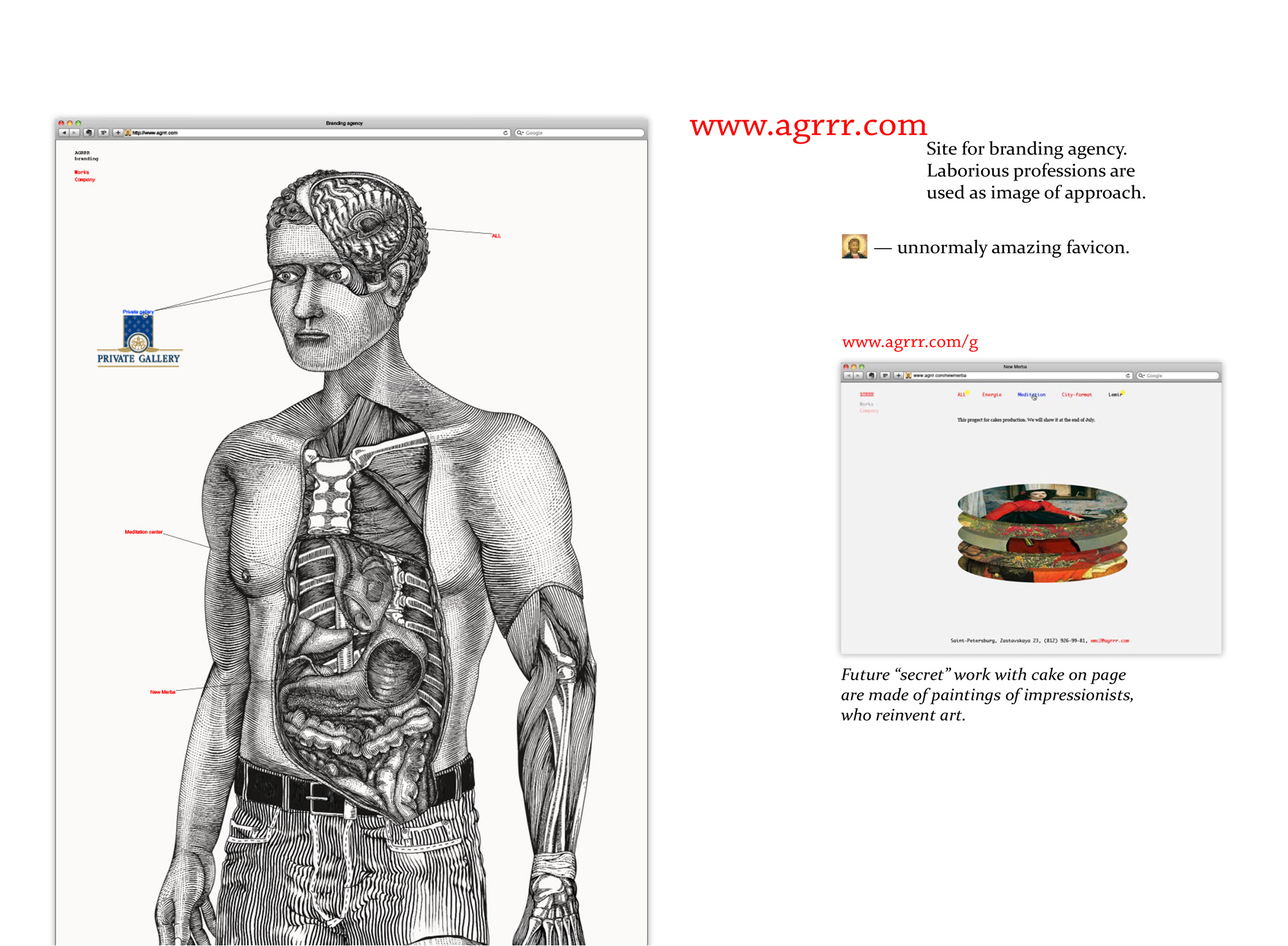
Подумав ещё разок, я решил, что все же неплохо было бы получить диплом. Так как меня только что уволили из лучшей студии в городе, то ничего не оставалось, как открыть собственную компанию по брендингу (конечно же). Мы объединились с менеджером проектов из прошлой компании, и принялись работать над нашим сайтом. Работали у него дома, придумывая название компании, звоня в другие дизайн-студии, чтобы лучше понять процесс их работы, и рисуя выдуманные проекты, чтобы заполнить портфолио. Студию назвали — agrrr.com. Почта у нас называлась — emc2@agrrr.com. А фавикон на сайте был буквально иконой Иисуса. Ведь в слове фавикон четко прослеживается слово икона.

В процессе подготовки мы поняли, что серьёзная компания не может быть без офиса, и поэтому сняли помещение в складском комплексе за 6 000 рублей, 15 кв. м, в самых недрах промышленной зоны. В соседнем от нас помещении ночевало 50 мигрантов, работающих на стройке, а туалет был непригоден даже для мух — они мерли там от ужасного вида и вони.

13 февраля 2010 года мы запустили наш сайт, и я написал письмо Олегу Тинькову, который тогда был на пике популярности в ЖЖ. ЖЖ — блог платформа, по сути предшественник текущих социальных сетей. Письмо было следующего содержания:

Олег, привет!

Нам не нужны твои деньги. Но сегодня мы запустили компанию, которая занимается брендингом — AGRRR.com Если ты хочешь реально помочь начинающим предпринимателям, размести это письмо у себя в ЖЖ.

Олег его разместил, сказал, что даже сайт не посмотрел, просто решил помочь ребятам. Лучше рекламы для нас на следующий день после запуска сайта придумать было нельзя. По сегодняшним меркам, это если бы Тейлор Свифт разрешила нашей группе образованной вчера сыграть на ее разогреве. Успех и тысячи посетителей на сайте.

Мы начали получать заявки от клиентов, которые приходили с ЖЖ Олега. Одно из предложений было — участие в тендере от компании Мирель, крупнейшего производителя кондитерских изделий на Урале. В тендере мы победили и заключили контракт на космическую для нас сумму в 1,2 млн. Моя зарплата в предыдущей компании была что-то около 30 тыс.

На момент победы в тендере у нас даже компания зарегистрирована не была. И мы начали работать, не получив предоплаты. Чтобы зарегистрировать компанию и полететь в командировку в Челябинск до первых оплат от клиента, я занял у мамы 50 тысяч рублей на билеты.

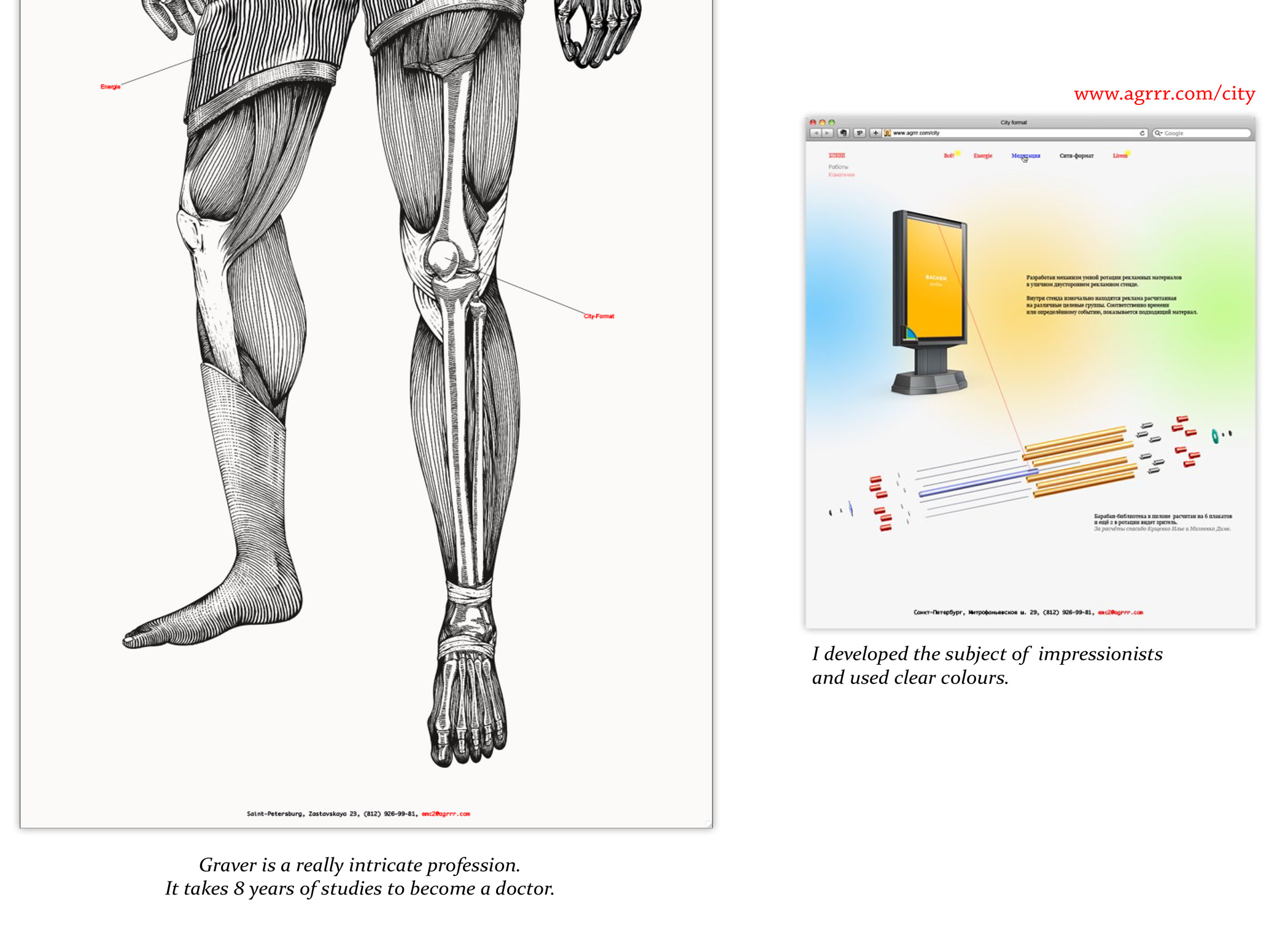
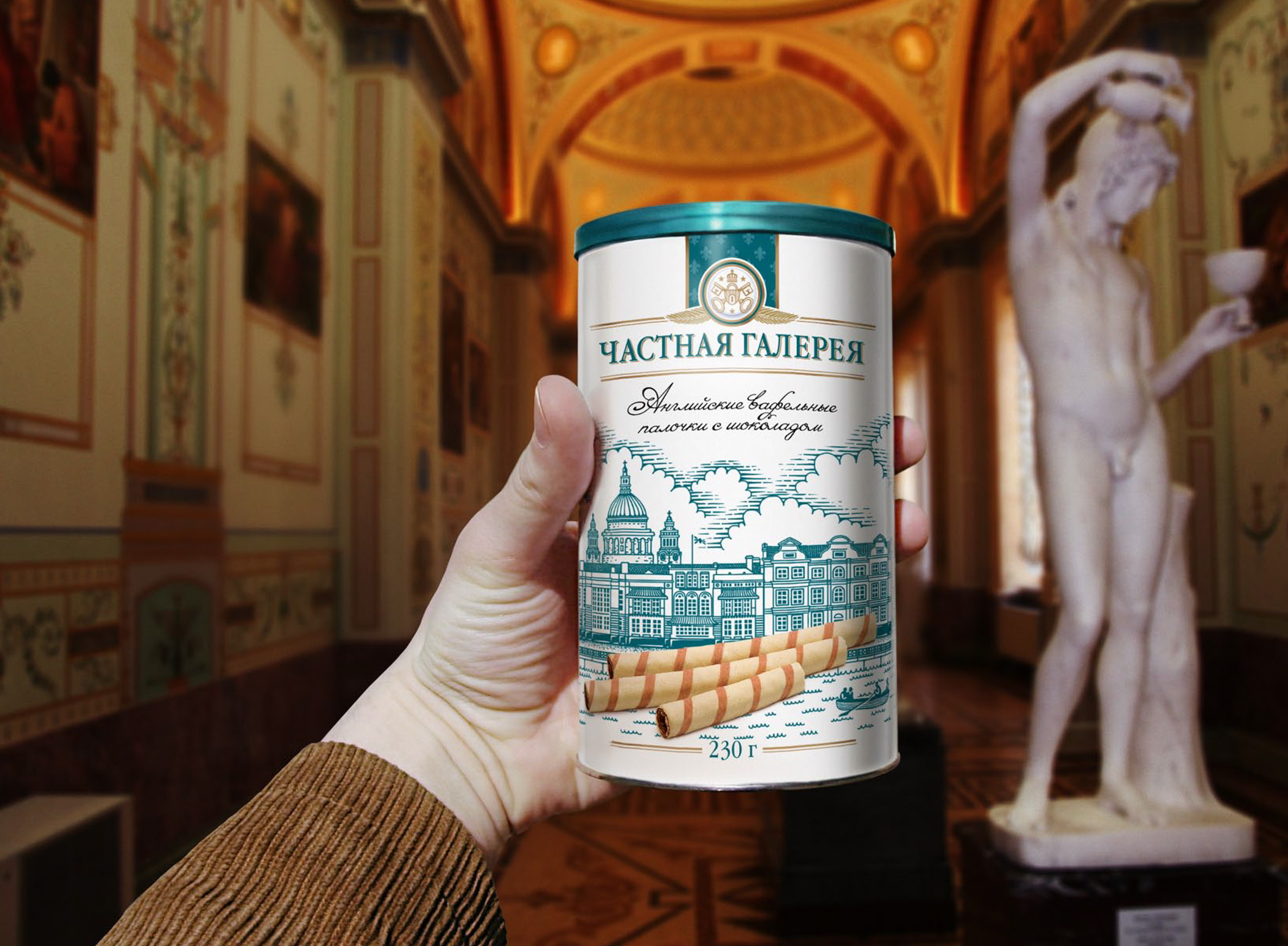
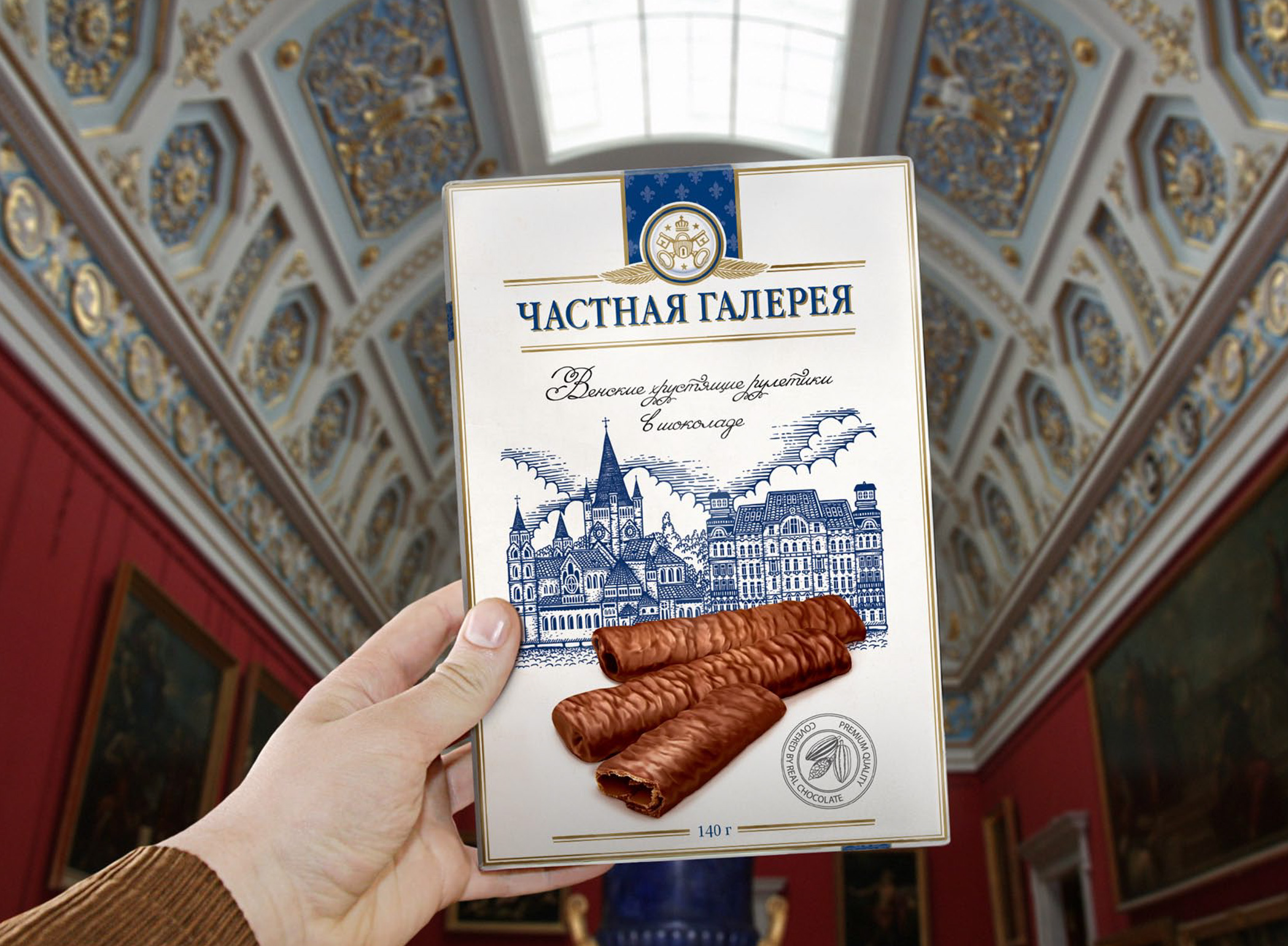
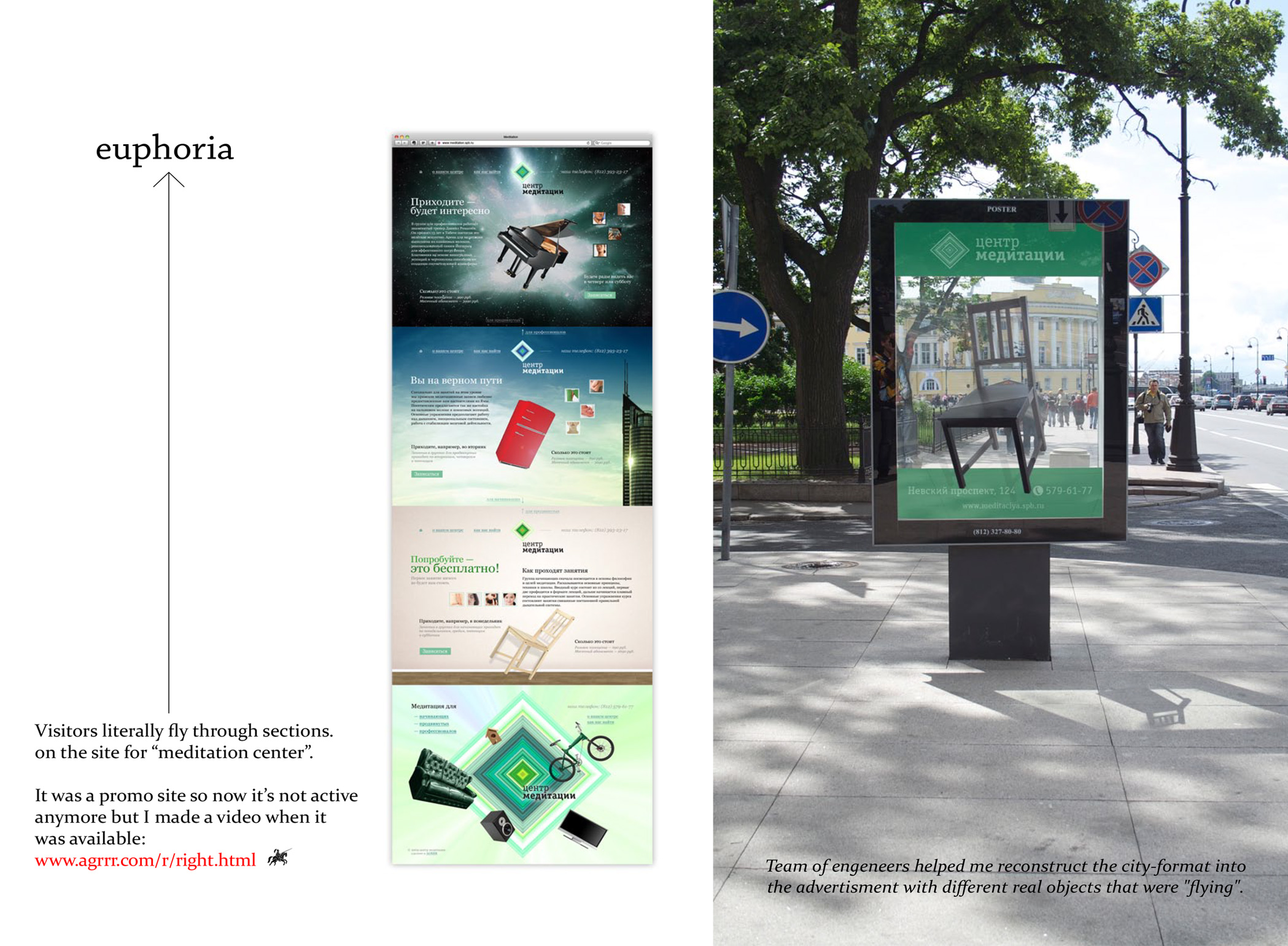
Portfolio slide for the agrrr.com branding agency site, an anatomical engraving of a man labeled with menu links. Portfolio slide with an anatomical engraving of legs and a screenshot of the agrrr.com city-format page. Hand holding a Chastnaya Galereya tin of chocolate wafer sticks inside an ornate gilded gallery hall. Hand holding a Chastnaya Galereya box of chocolate-covered wafer rolls under an ornate gallery ceiling. Portfolio slide showing meditation-center website screens and a street billboard with a flying chair. Vernern Brothers packaging slide, an apple juice bottle and pasta bag with engraved mechanism labels.
Некоторые работы которые мы успели сделать в Agrrr

Потом были: проверка службой безопасности (они не поняли, почему компания была создана в день подписания договора), командировки в Челябинск, лекции про тонкости рецептов тортов, 30 часов записи интервью с главными людьми на производстве, дорогой офис на 60 метров (а как же), первые сотрудники, конечно, бухгалтер на полный день, по совместительству сестра партнера (ведь компании из 5 человек нужен учет). Брендинговое агентство просуществовало 1 год, а потом я занялся уже другими проектами.

Без Олега Тинькова у нас бы никогда не вышло так взлететь на старте. Но главное, сигнал поддержки, акт одобрения и веры в предпринимательское начало, в текущих проектах импульс продолжается проявляться и в сегодняшних проектах. Думаю, мало кто сделал столько же для становления предпринимателей, которым сейчас 30-40 лет как Олег.

Олег, спасибо, ты класс!

How Oleg Tinkov helped me start my business in 2009

With all the buzz around Tinkoff Bank’s sad rebranding, I figured it’s the right time to share a story about how Oleg Tinkov actually helped me launch my first business back in 2009. And no, this isn’t one of those “he inspired me” stories, he really helped.

Hand-drawn red and blue outline of the Tinkoff crest, a knight and shield, above the word Tinkov.

Back in high school, I got into design, and by my first year of college, I was working at design studios around St. Petersburg. Around the same time, Oleg Tinkov started filming his “Business Secrets” – interviews with entrepreneurs he knew. I remember binge-watching those episodes. At the time, he felt like a total role model to me, this wild mix of rock’n’roll vibes, raw energy and fun, fearless marketing.

In my third year of college, in 2009, another economic crisis hit Russia and suddenly businesses lost much money. At the time, I was working in a company that focused on “premium” websites, not quick, cookie-cutter stuff, but full-on custom builds. We spent real time talking with clients instead of just handing them a generic brief and cranking out templated designs. But as the crisis hit, the head of the studio announced it was time to go assembly-line: fast, standard solutions. I was 20, full of idealism, and said no. Naturally, I got fired and honestly, it was fair.

After I got fired, I went to my parents and told them I had to quit school and immediately enroll in a design program in London, because I couldn’t grow in St. Petersburg anymore. They, quite reasonably, said no.

After thinking it over again, I decided that getting a diploma might not be such a bad idea after all. Since I had just been fired from the best studio in the city, there was really only one option left – start my own branding company (of course). I teamed up with a project manager from my previous job and we got to work on our website. We worked at his place, coming up with a name for the company, calling other design studios to better understand how they worked and creating fake projects to fill out our portfolio. We named the studio agrrr.com. Our email was emc2@agrrr.com and the favicon on the site was literally an icon of Jesus, because, well, the word “favicon” clearly contains the word “icon.”

While getting everything ready, we realized that no serious company could exist without an office. So we rented a space in a warehouse complex for $200, 15 square meters, deep in the heart of an industrial zone. Next door, there were about 50 migrant workers sleeping in their unit and the bathroom was so disgusting that even the flies couldn’t handle it, they basically dropped dead from the smell and the view.

On February 13, 2010, we launched our website and I sent a message to Oleg Tinkov, who at the time was hugely popular on LiveJournal. LiveJournal was a blogging platform, basically the predecessor to today’s social media.
Here’s what the message said:

Hi Oleg,
We don’t need your money. But today we launched a branding company – AGRRR.com If you really want to support young entrepreneurs, post this message on your LiveJournal.

Oleg posted it. He said he didn’t even have look at the site, just decided to help some young guys. We couldn’t have asked for better publicity the day after launch. By today’s standards, it’d be like Taylor Swift letting a band formed yesterday open for her show. It was a hit – thousands of people visited the site.

We started getting inquiries from clients who had found us through Oleg’s LiveJournal. One of them was an invitation to join a pitch for Mirel – the biggest confectionery company in the Urals. We actually won that pitch and signed a contract for what felt to us like an insane amount: $40,000. For context, my salary at the previous company was around $1,000.

At the time we won the pitch, we hadn’t even registered the company yet. And we started working without any upfront payment. To officially register the company and fly to Chelyabinsk for our first business trip, all before we saw a single ruble from the client, I borrowed $1,700 from my mom to buy the tickets.

Portfolio slide for the agrrr.com branding agency site, an anatomical engraving of a man labeled with menu links. Portfolio slide with an anatomical engraving of legs and a screenshot of the agrrr.com city-format page. Hand holding a Chastnaya Galereya tin of chocolate wafer sticks inside an ornate gilded gallery hall. Hand holding a Chastnaya Galereya box of chocolate-covered wafer rolls under an ornate gallery ceiling. Portfolio slide showing meditation-center website screens and a street billboard with a flying chair. Vernern Brothers packaging slide, an apple juice bottle and pasta bag with engraved mechanism labels.
Some of the works we managed to do at Agrr

Then came the security check, they couldn’t figure out why the company had been registered on the same day the contract was signed. Trips to Chelyabinsk, lectures on cake recipes, 30 hours of interviews with key people at the factory, a fancy 60-square-meter office (obviously), our first employees, and of course, a full-time accountant, who also happened to be my partner’s sister (because obviously a five-person company needs proper bookkeeping). The branding agency lasted about a year, and after that, I moved on to other projects.

Without Oleg Tinkov, we’d never have taken off like that at the start. But more than that, it was a signal of support – an act of belief and approval in the spirit of entrepreneurship. That same boost still shows up in the projects I’m working on today. I don’t think many people have done as much for entrepreneurs now in their 30s and 40s as Oleg has.

Oleg, thanks, you’re cool!

Игра-симуляция «Как будет развиваться AI в следующие 5 лет?»

В выходные было два полных дня на симуляции, посвященной теме того как будет развиваться AI в ближайшие 5 лет. Играли 36 человек. Сама игра проверка и тренировка: лидерства, работой с неопределенностью, переговорных навыков, формированием коалиций, каскадным взаимодействием. В прошлом году участвовал в аналогичной симуляции, только посвященной геополитическому конфликту. 

Abstract red and blue line drawing resembling a swirling funnel or vortex on white.

Механика игры

Все были поделены на команды, которые представляли акторов рынка: 

  1. Состоявшиеся лидеры ИТ рынка — прототипы Гугла, Майкрософта, Меты, Алибабы;
  2. Стартапы в AI — прототипы: Anthropic, OpenAI;
  3. Производители вычислительных чипов — IBM, Nvidia;
  4. Венчурные инвесторы — GP, Standard Investments;
  5. Конгломерат — X, во главе с Маском;
  6. Регулятор, пресса, суд. 

35 человек распределены по командам и каждому назначены роли с описанием: личных целей, состояния компании, положением индустрии, взаимоотношением внутри команды, проценты долей компаний между собой итд.

Каждый член команды имел «характеристики»: количеством люди в команде, объемом вычислительной мощности, бюджетом, дебиторской задолженностью итд.

Дальше было 5 раундов, по полтора часа каждый. Функционал, для действий неограничен: переманивай людей из других компаний, подавай в суд или привлекай регулятора, поднимай раунд на строительство заводов для увеличения мощности вычислений. Разрешено — любое действие, но модераторы, суд или регулятор, могут остановить реализацию действия, наложив вето. 

В конце каждого раунда зафиксированные договоренности передаются модератору, результаты сводятся в табличку по каждой компании, которую увидят команды по итогу. В табличке меняется ключевые показатели, изменившихся за раунд от количества игроков в команде, до свободных средств на счету. 

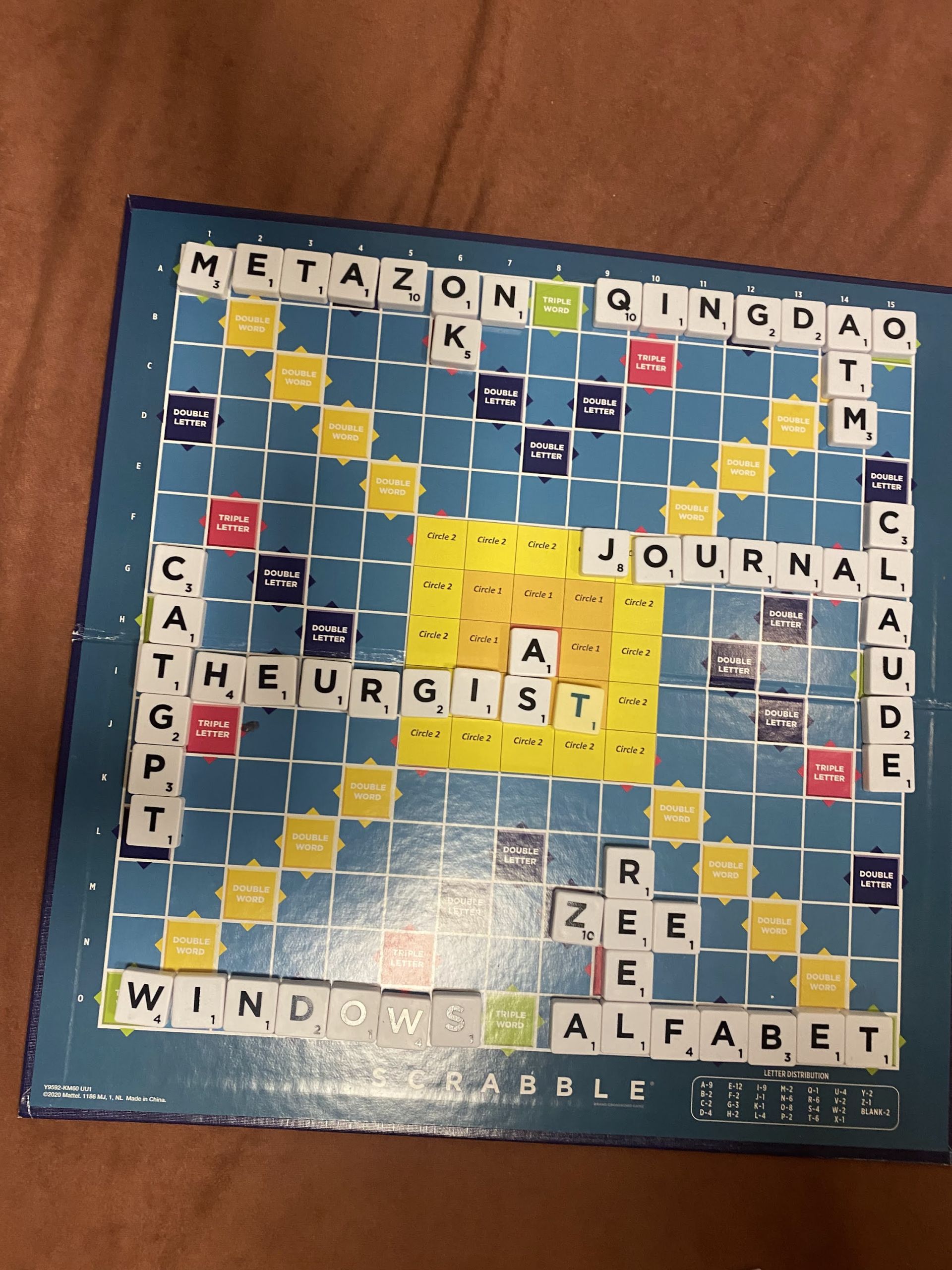
Главная задача команд — добиться сингулярности, для этого используется механика скрэббл. В конце каждого раунда выдаются буквы, количество букв зависит от количества людей в команде и вычислительной мощности, но формула получения букв не известна никому кроме организаторов, зависимости не прямолинейные. 

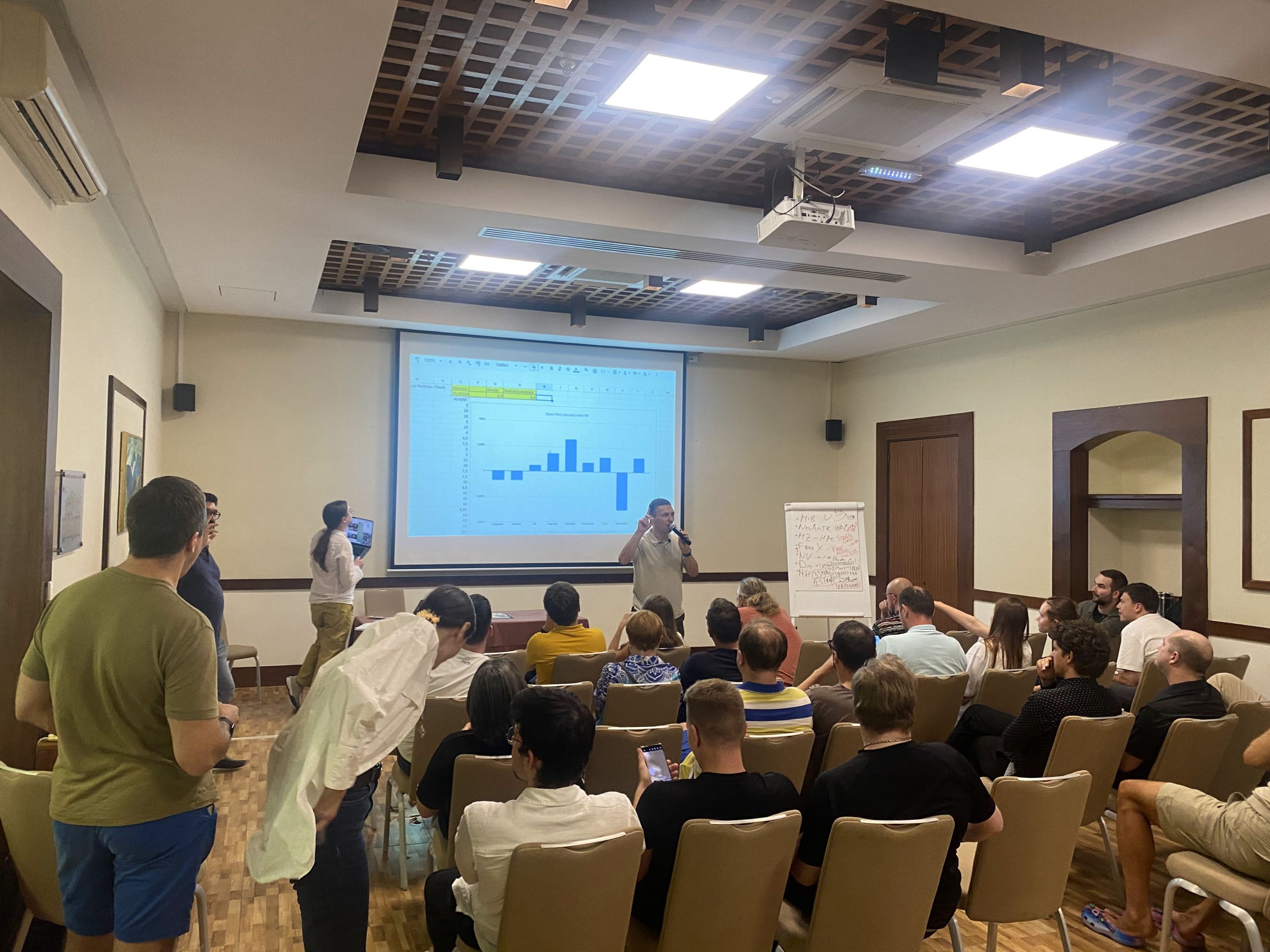
People seated in a conference room watching a presenter with a mic and a spreadsheet chart on the projector. Scrabble board filled with playful words like METAZON, QINGDAO, CATGPT, THEURGIST, CLAUDE and JOURNAL.

Рефлексия после игры

1. Роль, которая выпала — условность. 
Моя роль — тим лид, в компании прототипа OpenAI, далеко не ведущая позиция. Когда пошел договариваться с другими командами, меня спрашивали — какая у меня позиция в компании и могу ли я принимать решения. Но я пояснял, что я пришел от команды, и не важна какая у меня роль. Тут — молодец. Но когда были выборы президента, подумал — тут же есть изначльно более заметные роли, Маск например, зачем выдвигаться. Роль условность, в игре и в жизни. Но удобно находить себе оправдательные механизмы для бездействия. 

2. Всегда-всегда лидируй.
В начале игры мы излишне много потратил времени на объяснение того, что каждый собирается делать. Но стоило определить видение желаемого результата, и начать действовать скорее. Приходя уже с концертным результатом, и фиксируя его с командой. Думаю мотивы затянувшегося обсуждения — страх взаимодействия с другими командами, и желание не брать ответственность каждого по отдельности, желание размазать ее между всеми. 

3. Если не получил нужного результата, не скорби, продолжай действовать. 
Когда мои или командные действия не приводили к результату, меня захватывали эмоции. Но несколько раз в такие моменты, делались экстра усилия и ситуация неожиданно позитивно разрешалась. Всё больше убеждаюсь, что холодный ум быстрее приводит к результату, не скатывайтесь. 

4. Оцени социальные связи, до начала действий, используй это. 
Компьютерные мощности на момент старта игры производили 3 команды, первые 2 команды к которым я подошел отказаться с сотрудничать. Но третья команда, где был представитель с которым знаком до игры, пошли на встречу. Убежден, далеко не последним стал тот факт, что было сформировано доверие, ещё до начала игры. Этим надо пользовать и управлять и в жизни. 

5. Думай в целом об игре, когда работаешь в текущем раунде. 
Желание сосредоточиться на коротко срочном результате понятно — хочется предсказуемости, а через два шага не известность растет. Но тактическая позиция сужает варианты выбора поведения. Если же иметь волю к долгому проекту, на несколько тактов, то и созвездие вариантов окажется многообразнее и с потенциально большим результатом. Например, начиная работать над коалицией с первого раунда, мы смогли ее собрать только к 3-му — опередив другие команды.

6. В условиях неопределенности, сфокусируйте на поиске возможностей.  
В условиях неопределенности и многосторонности интересов, хочется сфокусироваться на своих интересах — ведь так проще, в твоей роли написан четко задачи. Но если на секунду остановиться то можно понять, что каждый будет делать так вначале, а потом поймут что единственный способ победить — сотрудничать. Поэтому с самого начала создавай возможности, которые усилят твою позицию и позицию другой команды. В итоге победила та команда, кто с первого раунда начала образовывать коалицию. 

7. Сначала пойми контекст — потом действуй, но не затягивай.
Описание роли участников и контекста игры много плановое. Инструкцию получаешь перед началом игры, сразу охватить ситуацию невозможно. Мы с командой начали разбираться, но в какой-то момент превысили достаточность обсуждений и потеряли время, которое можно было бы потратить на полезные активности. Контекст, надо изучать в коммуникации с внешним миром, а не в своем мирке.

8. Не прекращай действовать, пока не получил подтвержденный результат. 
Когда в сделке участвует несколько команд, то кажется что вот уже договорились. И можно думать о следующем шаге, исходя из новой позиции. Но сделка развалилась не раз, в момент подписания сторонами соглашения. Пока не подписали соглашение — не отвлекайся, доводи дело до конца. 

9. Распределяй зоны ответственности. 
Не раз мы собирались с командой, чтобы провести переговоры с другой стороной. При этом позицию слушали сразу всей командой — что не эффективно. В игре, как и в жизни много задач и слоев, где действовать. Чтобы действовать эффективнее, стоит распределить зоны ответственности, и вести работу параллельно. На второй день у нас вышло договориться об этом, и эффективность команды возросла. 

10. Синхронизируйся, убедись что все понимают контекст одинаково. 
При подписании ряда договоров, у оказывалось, что кто-то ключевой имел иное представление о принципах сделки, и это разрушало ее. Ключевые моменты, стратегия должна четко озвучиваться вначале. 

Спасибо за организацию игры Марату Атнашеву и Тимур Атнашеву и команде. 

Simulation game: “How will AI develop over the next 5 years?”

At the weekend, we spent two days on a simulation all about how AI might evolve over the next five years. There were 36 players involved. The game itself is a test and workout for skills like leadership, dealing with uncertainty, negotiation, building coalitions and cascading teamwork. Last year, I took part in a similar simulation, but that one focused on a geopolitical conflict.

Abstract red and blue line drawing resembling a swirling funnel or vortex on white.

Here’s how the game worked

Everyone was split into teams, each representing a key player in the market:

  1. Established IT leaders – companies like Google, Microsoft, Meta and Alibaba;
  2. AI startups – like Anthropic and OpenAI;
  3. Chipmakers – companies like IBM and Nvidia;
  4. Venture investors -GP and Standard Investments;
  5. Conglomerate – X, led by Musk;
  6. Regulators, the press and the courts.

35 people were split into teams and each person got assigned a role with details like personal goals, company status, industry position, team relationships, company ownership percentages, etc.

Each team member had their own “stats” like the number of people on their team, computing power, budget, accounts receivable and more.

There were 5 rounds, each lasting about an hour and a half. You could do pretty much anything: lure talent away from other companies, sue someone or get regulators involved, raise funds to build new factories to boost computing power. Any move was allowed, but moderators, the court or regulators could step in and veto an action.

At the end of each round, all the agreements made were handed over to the moderator, who compiled the results into a spreadsheet for each company. The spreadsheet tracked key stats that changed during the round, covering everything from team size to available cash.

The main goal for each team was to reach singularity, they used a Scrabble-like mechanic for that. At the end of each round teams got letter tiles, the number of letters depended on team size and computing power. But the exact formula of how letters were awarded was a secret, known only to the organizers and it wasn’t a straightforward calculation.

People seated in a conference room watching a presenter with a mic and a spreadsheet chart on the projector. Scrabble board filled with playful words like METAZON, QINGDAO, CATGPT, THEURGIST, CLAUDE and JOURNAL.

Post-game takeaways

1. The role you got is just a formality.
My role was a team lead at a company like OpenAI, not a top position. When I started negotiating with other teams, they asked what my position was and if I could make decisions. But I explained I was there representing the team and my role didn’t really matter. Very good. When it came time to run for president, I thought, there are already bigger names in the game, like Musk, so why even bother? Roles are just labels, both in the game and in real life. But it’s easy to use them as an excuse.

2. Always lead, always.
At the start of the game, we spent way too much time explaining what everyone planned to do. But as soon as we nailed down a clear vision of the goal and just got moving. Coming in with a plan and sharing it with the team really helped. I think the long talks happened because people were afraid to work with other teams and didn’t want to take responsibility alone. They wanted to share it so no one felt fully in charge.

3.If you don’t get the result you want, don’t overthink it – keep going.
When my or the team’s actions didn’t pay off, I got caught up in my emotions. But a few times when I pushed through and made an extra effort, things surprisingly turned out well. I’m more convinced than ever that keeping a cool head gets you results faster.

4. Look at your social connections before you start and use them.
At the start of the game only three teams had computing power. The first two teams I asked didn’t want to work with me. But the third team had someone I already knew and they agreed to cooperate. I’m sure the trust we built before the game helped a lot. You should use this kind of trust and manage it, both in the game and in real life.

5. Keep the whole game in mind while working on the current round.
It’s normal to want quick, predictable results. But if you only focus on the short term, your options get limited. When you plan for the long game, looking ahead several rounds, you open up more possibilities and better chances to succeed. For example, we started building a coalition in the first round and didn’t finish it until the third, but that gave us a lead over the other teams.

6. When things are uncertain, focus on finding opportunities.
In uncertain situations with lots of different interests, it’s easy to just stick to your own goals – your role makes them clear and it feels simpler that way. But if you pause for a second, you’ll see everyone starts like that and the only way to win is by working together. So from the very beginning, look for chances to boost both your position and the other team’s. In the end, the team that began building a coalition right from round one won.

7. First, get the context – then take action, but don’t take too long.
The roles and rules are detailed and you get all the info just before the game starts, so it’s impossible to understand everything right away. My team spent time trying to figure it all out, but we ended up talking too much and wasting time we could use to do something. You learn the context by engaging with others, not by staying stuck in your own little world.

8. Keep taking action until you get a confirmed result.
When several teams are involved in a deal, it can feel like you’ve already agreed and can move on to the next step. But deals have fallen apart more than once right at the signing. So until the agreement is actually signed, don’t get distracted, follow through all the way to the end.

9. Split up the responsibilities.
More than once, our whole team went to negotiate with another group, all of us listening at the same time, which wasn’t very efficient. In the game, just like in real life, there are lots of tasks and layers to handle. To work better, it’s smarter to divide the responsibilities and work on things at the same time. On the second day we did that and our team got way more efficient.

10. Stay in sync and make sure everyone’s on the same page.
When signing some deals, it turned out that key people had different ideas about how things should work and that ended up breaking the deal. The main points and strategy need to be clearly explained from the beginning.

Thanks to Marat Atnashev, Timur Atnashev and their team for organizing the game.

Earlier Ctrl + ↓