
When a product grows, the team almost always ends up with different versions of reality. Marketing sees one audience, product sees another, support sees a third. Then we argue about segments based on intuition, the loudest voice wins the roadmap, and research stays in a folder and changes little.
In this case study, I show how I built one shared picture using LTV data, ABCD segmentation, and deep JTBD interviews. Then I turned the results into clear segments, customer language, and practical decisions for the product and communication. I also explain how I used AI live translation so I could talk to customers in their native language (Spanish), even when I do not speak it.
I do not share the company name and the exact numbers on purpose. In the screenshots, the data is fictional, but it still shows the right meaning.
Goal of the Research
Here is what I needed to do:
- Stop inventing audience segments, and build them from real facts and real user voices.
- Agree on the focus: who we serve best, and what value we deliver better than competitors.
- Understand which customers actually keep the economics working.
- Create artifacts that help other departments act and align with the needs of a particular segment.
My Pre-Interview Setup
For research like this, I build the process from scratch: first I align terms and expectations → then I collect facts → after that I write testable conclusions and turn them into concrete decisions with clear priorities. This removes subjectivity and makes it easier to pass the result between teams.
The project had four steps:
- Aligning views inside the company.
- Quantitative segmentation by LTV and ABCD segmentation.
- Deep interviews in JTBD logic.
- Writing clear customer jobs.
Step 1. Running an Internal Team Workshop Alignment
At the start, I ran a workshop where I set the JTBD frame:
People choose a product as a tool to solve a specific task. It is important to see the context, triggers, success criteria, trade-offs, and alternatives — not a list of desired features.
Then the team described its current view of segments: who they see as key, what they promise them, where the product magic is, and which jobs it covers. We compared the maps, captured the differences, and agreed: from here we test hypotheses with data and interviews, not with personal beliefs.
Step 2. Economics: LTV and ABCD segmentation
To make sure interviews did not turn into talks with random people, I started with the customer base. Using seven months of data, I split users by LTV ranges and calculated group size, average number of purchases, revenue, average LTV.
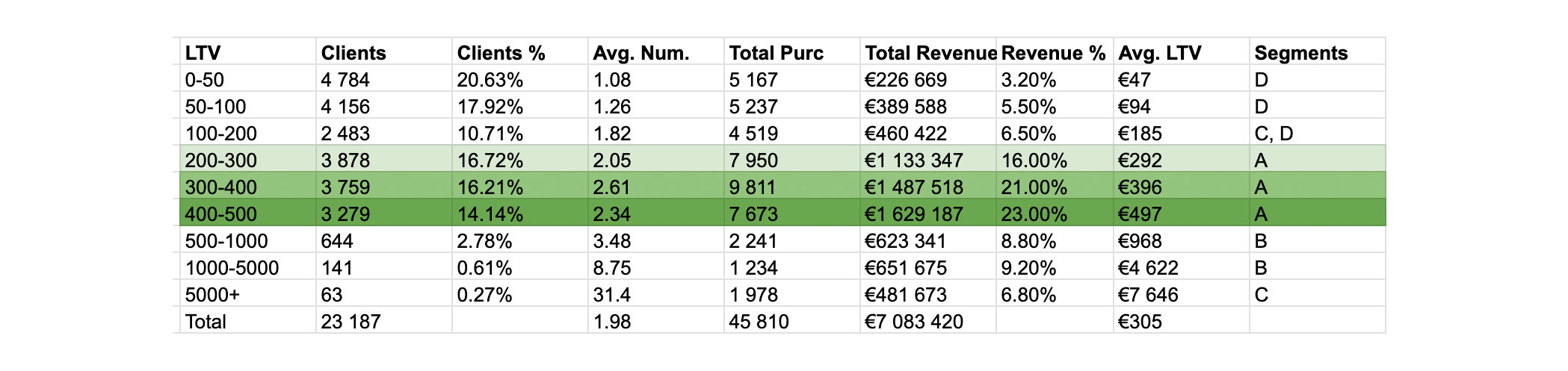
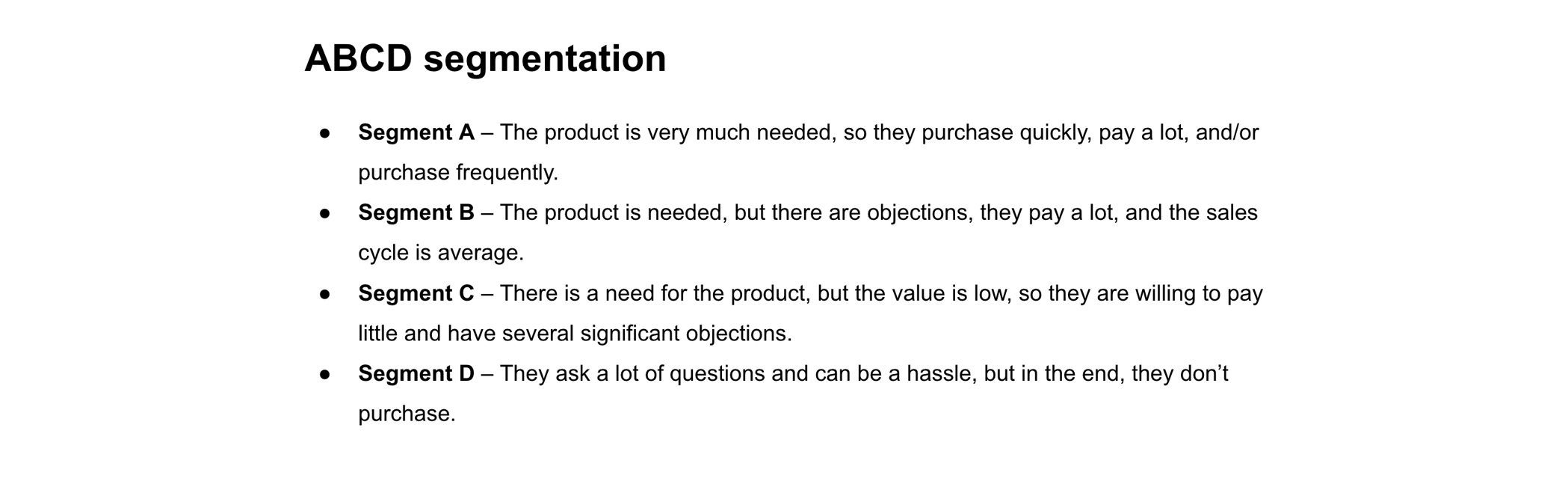
This is where the first “cold shower” happened, and it made the discussion clear right away: a clearly defined share of LTV customers brought most of the revenue. That gave the research an honest focus. We wanted to understand:
- who these people are;
- why they choose us;
- how to scale this success without drowning in endless service for low-value customers.
Step 3. In-Depth Customer Interviews to Identify Segment Patterns
The goal of the interviews was to understand why the client chose our product:
- what happened before the purchase;
- what became the trigger;
- what options they compared;
- where they hesitated;
- when the feeling appeared: “aha, this works”;
- how the customer defines success.
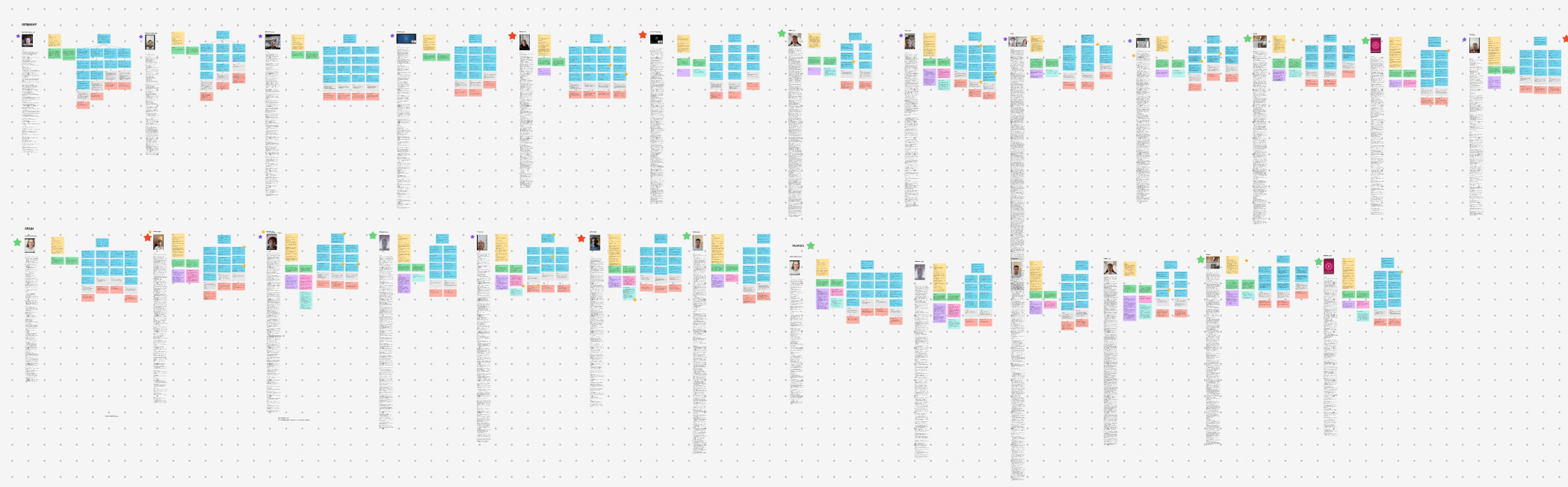
In each session, I captured the profile, trigger, aha moment, problems, customer jobs, and signals of disappointment. At the same time, I collected live quotes: the phrases people use to describe their goal and progress. Later, this language works great in marketing, onboarding, and product messaging.
I ran the interviews in Google Meet, and I recorded and transcribed them with Loom. Some conversations were in Spanish: I used a new Google AI service that does live, two-way translation in real time from Spanish to English and back.
Timing made one thing clear fast: 90 minutes gives better quality than 60. People have time to move past general phrases and get to the real reasons and trade-offs.
I planned to do 25 interviews. But by the 20th, I saw that the key motives and conflicts were repeating — so I stopped earlier.
Step 4. Defining Three Key Segments and Their Qualification Criteria
After the interviews, I built the segmentation so it works in real life. Not abstract portraits, but criteria that help the team confidently assign a customer to a group and understand how to work with them. I looked at:
- goals and motivation;
- risk attitude;
- experience;
- discipline;
- routines and rituals;
- learning and decision-making styles.
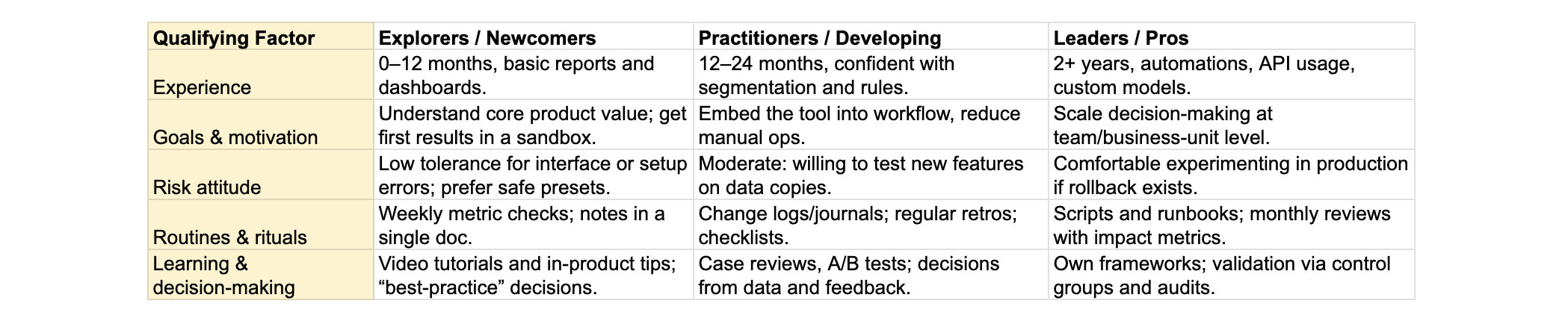
Inside the segments, I saw repeating patterns: how people describe the goal, how they measure results, and which limits they see as critical. I put them into a separate block so other departments could better understand what our clients think about and how they make decisions.
Another artifact was a matrix of selection criteria and reasons why some customers choose competitors. It connected the customer voice with the market picture and helped us define clear points of comparison across segments.
How I made the results accessible to the whole company
One typical research risk is that knowledge stays with the researcher and dies when the context changes. To avoid that, I built an internal AI agent based on the project materials: transcripts, tagging, insights, and also external sources. Teams could ask questions and get answers grounded in real interviews and quotes, including in different languages.
This sharply increased the visibility of the knowledge portfolio: product, marketing, and support started to speak the same language and return to the source data faster when decisions were disputed.